OUR HISTORY:
Kifaru Youth & Children Centre was founded by a man from a rural village called G Lambo. His name is Kilian. As a boy, Kilian lived a very hard life.
According to the traditions of our ancestors, the villagers believed in evil spirits and practiced rituals. But these belief systems placed strict and harsh conditions on those who strayed from tradition or broke the rules. Villagers were not allowed to learn modern teachings. Those who did could be killed. The local traditions police would come late at night to the homes of violators and take them away.
Young women who became pregnant before marriage also risked death. They would be separated from the village and taken into the bush where they would stay in a simple shelter until childbirth. Even married women risked death during pregnancy at the hands of traditional village doctors. Compounding the problem, women were not allowed to talk publicly of these risks. Government investigations went nowhere.
It is small wonder then, that girls would run away from their homes to try to save their own lives.
Unfortunately, even on their own, their lives were not much safer. To care for themselves, they often sold their bodies on the streets. Many contracted diseases like HIV/AIDS and became pregnant again, perpetuating the cycle of early death and orphaned children.
During this time, the number of Karatu area street children increased to new highs in each consecutive year from 2005 through 2009. Yet no local leader took action. According to our founder, “the chiefs of the village were never worried or made any effort to follow up if someone went missing from the village for a week, months or even a year.” Instead, the traditional chief authorities treated the situation as ‘normal’. Government officials also ignored the problem, treating it as a village issue. As a result, the number of people infected with HIV/AIDs skyrocketed.
Kilian followed non-traditional views despite the risks. He became a guide on Kilimanjaro and later at the luxury safari travel company, andBeyond. He put his daughters through University. But Kilian never forgot his past. The pain of seeing young girls selling themselves on the streets in order to eat, homeless widows separated from the security of their villages and innocent children standing homeless and alone on the street was too much.
Kilian took action. He started to adopt homeless orphans, using his own earnings to cloth, feed, shelter and educate them. Other guides and community leaders soon joined him. He founded a football league to bring the community together, give youths an outlet and campaign for human rights and justice for children and youths in remote areas.
His work coincided with a change in Tanzanian NGO laws that enabled NGOs to work together with the Tanzanian Government to address some of these issues. Kilian began working with Mr. Abdallah Nyange, a social welfare worker. Together, the men began a much needed research project to help identify, monitor and solve the region’s social problems. KYCC has since expanded to include numerous projects, a food program, HIV/AIDS education, an environmental program to improve both the land and food available to poor people, data collection and monitoring of programs. Read on to learn about our programs.
KARATU, TANZANIA – AN OVERVIEW OF OUR POTENTIAL AND PROBLEMS
Peace and Potential in Land of Extreme Poverty
Tanzania has been politically stable and peaceful for over half a century and its economy consistently outperforms most sub-Saharan nations. Beautiful wildlife parks, like our own Serengeti and Ngorongoro Crater, bring in tourist revenue. Industry and telecommunications are growing and recent natural gas and mineral discoveries hold hopes for stronger growth. Yet, Tanzania’s people are amongst the hungriest and poorest in the world.
Rising Number of Orphaned Children
Extreme poverty, traditional beliefs and reduced respect for a child’s life contribute to this situation especially in rural districts like Karatu. In our district, at least 10,000 children have been abandoned or orphaned. Some 20% do engage in child labour, meaning they might eat each day. The vast majority barely survive. Girls are especially vulnerable since by tradition, they are married off as young teens and have little chance to develop survival skills for a modern society. All these paths put an end to schooling and hope for Tanzania’s future. Break this cycle and there is hope; Hope for better lives and a more developed, potentially emerging, country.
Our vulnerable youths live hand to mouth. Left: our colleagues make fire with local youths. Right: a catch.
Ritual Practices Endanger Children – Limit Education
Traditions can be sacred but they can also kill. Ours are killing our youth and our region’s future. The murders of our albino children for body parts (thought to improve the possessor’s luck) have made global headlines. Unfortunately, this is just one of many youth-killing beliefs. Others include the “planting” of live infants and toddlers in the earth to die, a ritual even most local villagers frown on.
The murder or expulsion of young, unwed pregnant girls is much more accepted since the girl is believed to have brought shame on the community. Many girls run away but end up selling themselves on the streets to eat. Here they risk contracting the HIV/AIDS virus and becoming pregnant. This simply perpetuates the cycle as they die of HIV/AIDS related illness leaving their orphaned children to a similar fate.
OUR KEY PROGRAMS – A SUMMARY:
-
Provision of basic needs:
-
Social protection framework for our young so they are cared for rather than beaten or killed.
-
Water, food, medical care, and shelter so children can be free to focus on learning.
-
Education and the loving care and guidance of adults with the aim of becoming a self-sufficient adult.
-
-
Long-term projects to help the community become self-sufficient and have a voice:
-
Improved human rights conditions including respect and care of our young people.
-
Health education focusing on HIV/AIDs, other sexually transmitted diseases and malaria.
-
Horticultural and gardening education to promote better access to healthy food.
-
Conservation education so our people can sustainably manage their wildlife resources and have a large voice in shaping their own rural development.
-
Promotion and training for budding entrepreneurs to encourage self-sufficiency, a stronger local economy, confidence and improved human conditions. This includes our own tree farm business: the community learns better growing techniques, the importance of trees in our environment and how to run a business.
-
-
Identification of the underlying causes of child poverty in our district. This is a key goal because, until now, there has been limited focus on identifying and responding to the needs and protection of our children. Our work includes:
-
Data collection and research so more appropriate programs can be developed.
-
Implementation and monitoring so the programs can be improved upon.
-
Working in conjunction with government and the local community to implement and improve programs.
-
PROGRAMS IN DETAIL
SOCIAL PROTECTION: STEP 1
We have established a program to take to task parents whose children have run away. Police and our Social Welfare Department now work in tandem with us to make sure parents take back their children, properly feed and cloth them and make sure they go to school. Our program monitors developments to ensure the security and protection of the child. So far, over 800 runaway children, have been re-united safely with their families. Before this, the problem of runaway and abused children was largely ignored.
Food drives to help poverty stricken parents and runaway children have helped this process. So far we have funded the purchase of almost 50 kg of maize (about 1500 meals) and 15 kgs (about 3000 meals) of beans to help feed these people. We thank our contributors, as we could not have done this alone.
Our founder and colleague serving up food, clean water and companionship. Our team meets to review and plan.
Our aim is to build on these first steps so more and more children and parents can lift themselves out of abject poverty, and become self-supporting; so that fewer and fewer traditions result in death.
Orphans at KIFARU Youth and Children Centre may be shy at first but soon they are smiling, giggling and learning!
EMPOWERING YOUNG CHILDREN THROUGH CLUBS
KYCC founded Children’s Rights Club (CRC) to help young children improve their own situation. Through our Children Right Club, we can deliver our message that “we fight for freedom; we are the way to truth and justice.”
Pictured here, our youths and children putting words by Nelson Mandela to music. They sing, “We are the children!! We need equality and justice to live in a way that respects and enhances the freedom of others.”


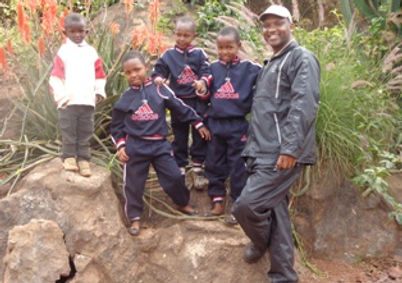
orphancs children with our founder

if you want to support our children check on sponsor a child page. thanks you very much.